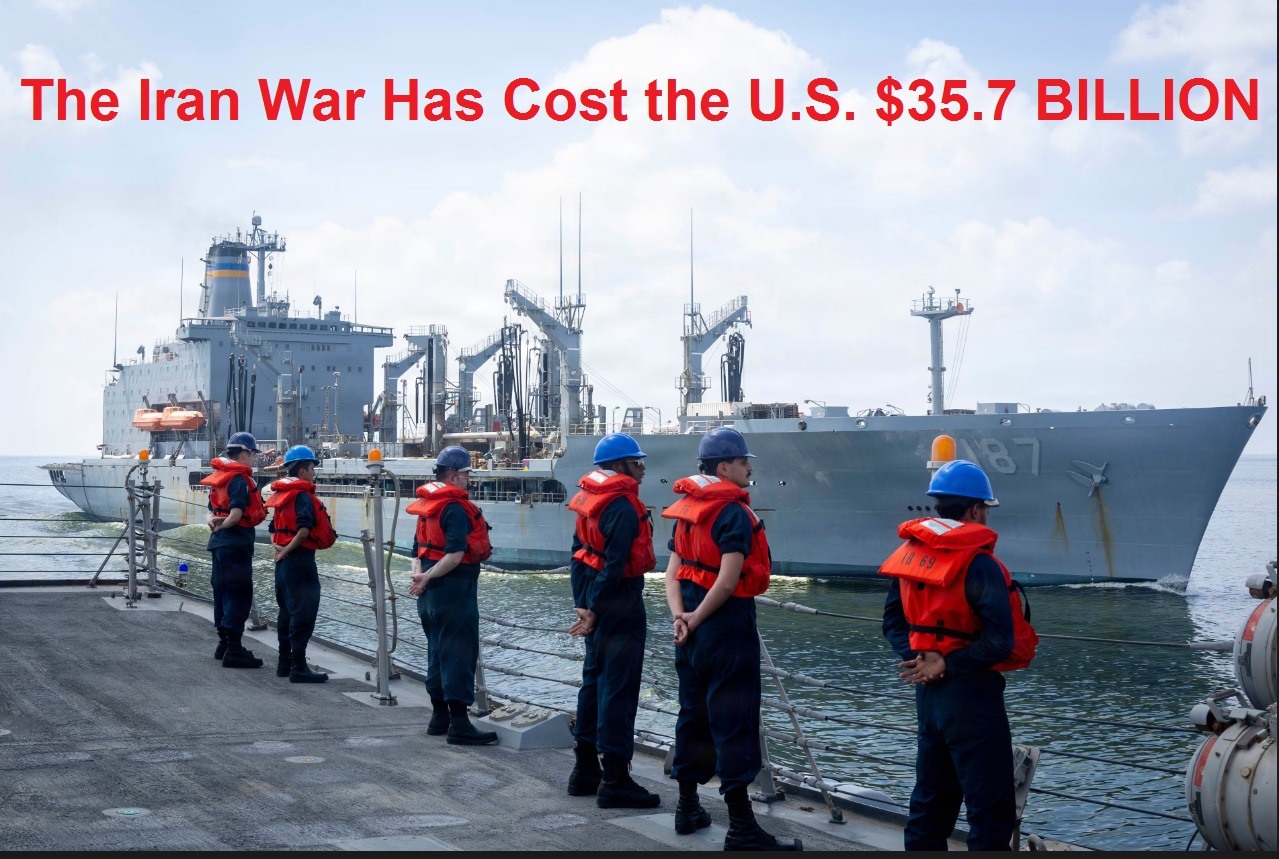
Image Source [1].
by Brian Shilhavy
Health Impact News
After 6 months and $35.7 BILLION in spending, the Zionists’ war against Iran [2] has only made matters in the Middle East worse than they were before the war started.
Oil flowing through the Strait of Hormuz is still restricted, driving up energy costs, with Iran still fully in control. No oil was restricted from passing through the Persian Gulf before the war started.
Russia has benefited from all of this military spending, as it has diverted funds and weapons from Ukraine, and earlier this week the head of the CIA made a secret trip to Moscow, allegedly because they received intelligence that Russia was about to start attacking NATO countries.
China has found many ways around the disruption of oil flowing through the Strait of Hormuz, and has reportedly imported close to the same amount of oil flowing through the Persian Gulf as before the war.
Meanwhile, U.S. military members in the Navy have suffered very poor conditions from long deployment at sea leading many to suicide attempts, and it was just reported in The Guardian that the U.S. Navy has had to divert funds from their payroll to pay the costs of this war.
Here are some of the articles I have posted on our Telegram Channel [3] recently.
Trump’s war on Iran is rapidly draining US navy budget, documents and interviews reveal
Exclusive: Experts and former officials say accounts are running dry, and funding a war with no clear endgame is the main challenge
From The Guardian [4].
Excerpts:
Donald Trump’s war on Iran has driven the US military into a severe financial crisis, with the US navy forced to transfer money from its payroll and other sources to cover the costs of combat, according to documents seen by the Guardian, and interviews with navy officials, contractors and defense analysts.
The US-Israeli operation, which has depleted US munitions stockpiles and prompted retaliatory Iranian strikes that have wrecked strategic bases across the Middle East, is piling pressure on budgets across the military.
One Pentagon memo about navy funding seen by the Guardian warns that there are “shortfalls in payroll” accounts due to the department “raiding” them to fund combat operations.
Experts and former officials say the accounts are running dry. “The piggy bank is broken,” said Harlan Ullman, a retired naval officer. Ullman is a member of the National Commission for the Future of the Navy but he said he is not speaking on the commission’s behalf.
One official and one navy contractor said non-emergency maintenance on shore-based facilities has been deferred because of the cash crunch.
When Trump started the war on 28 February, it quickly strained the military’s existing budgets – particularly that of the navy, which not only helped launch the initial wave of attacks but was later responsible for an extensive naval blockade. The White House eventually asked Congress for emergency funding to pay for the war efforts, but prospects that the request will be approved are dim amid the unpopularity of the war.
A navy official who was briefed on how the service is planning to address the shortfalls said money is shifted around in imaginative ways.
“The money for payroll,” he said,
“was robbed to pay for overseas contingencies and is being backfilled by money that hasn’t been spent. They are backfilling payroll so we get enough money in our paycheck.”
China’s imports of Iranian oil ‘largely untouched’ by US siege: Report
From The Cradle [5].
Excerpts:
China has received about 1.2 million barrels of Iranian oil per day this year so far, just a touch less than during the same time in 2025, according to information from industry data provider Kpler, cited by the New York Times [6](NYT) on 25 August.
According to Muyu Xu, a senior Kpler oil analyst, large quantities of oil are now sitting on ships and in storage tanks near the Malacca Strait and South China Sea.
“Up-to-date volumes are difficult to measure because ships have become increasingly skilled at evading detection,” Xu was cited as saying by NYT.
The number of barrels of Iranian oil received is only “slightly less” than last year.
“Iranian oil is frequently transported to waters off Malaysia, where cargoes are transferred between vessels before continuing to Chinese ports,” the US outlet writes.
NYT added that the “Trump administration risks a clash with Beijing as it tries to cut off Iran’s economic lifelines without upending a fragile US–China truce,” referring to the US–Chinese trade and tariff war that is currently on hold.
Beijing has strongly condemned Washington’s declaration of a new economic war against Iran.
China warned [7] Washington on 25 August that it is ready to respond to “maximum pressure” and “economic isolation” pursued by the US.
“An economic war and maximum pressure will not help resolve the issue,” said Chinese Foreign Ministry spokesperson Lin Jian.
“They will only further intensify contradictions and conflicts, cause risks to spill over, disrupt the global economic and financial order, and harm the legitimate rights and interests of other countries,” he added.
“China is closely following the relevant developments and will take all necessary measures to firmly safeguard its own rights and interests.”
The Iran War Has Handed Russia a Strategic Opening in Europe
From OilPrice.com [8]
Excerpts:
The war with Iran has handed Russia a strategic advantage in Ukraine. Washington is burning through the weapons Europe needs to deter Russia, moving military capacity into the Gulf and simultaneously telling NATO governments to take over more of their own defense.
CIA Director John Ratcliffe flew to Moscow this week precisely because of the connected nature of these two problems. He met Russian foreign intelligence chief Sergei Naryshkin in the first known visit by a CIA director since William Burns traveled there in late 2021, just before Russia invaded Ukraine.
Ratcliffe warned Moscow against attacking a NATO member and tried to bargain for support against Iran, likely using talks with Ukraine as bait. Washington asked Kyiv to suspend strikes during the visit.
Trump has called the trip “semi-routine” and says he is not worried Russia will attack NATO, but the circumstances suggest otherwise.
Air defense is the immediate challenge, with Patriot interceptor stocks in Europe “beyond critical”, depleted by the war in Iran. U.S. forces now have very limited ability to defend against even a single Russian ballistic missile strike, and there are not enough Patriots to absorb a sustained attack.
The Pentagon and NATO may dispute that assessment or attempt to frame it in softer language, but there is no dispute that large numbers of interceptors have been moved out of Europe and used in the Middle East.
It will take years to replace them at volume.
Hormuz Shipping Remains Subdued Despite Apparent Reopening
From OilPrice.com [9]
Excerpts:
Hormuz is “open”, but nowhere close to functioning normally.
The U.S. has cleared mines from the internationally recognized shipping lanes and can technically get vessels through, but Iran’s military capability will still keep most commercial operators away.
Only five commodity vessels crossed on Tuesday, compared to some 130 ships a day before the war.
Iran is offering a temporary and limited corridor while making full normalization conditional on sanctions relief, an end to the U.S. blockade and, now, an end to Israeli operations in Gaza, Lebanon and Syria.
The Israeli demand is a non-starter. Washington cannot guarantee that Israel will stop military operations in three separate theaters, and Israel has shown little willingness to comply at any point in this war.
But Trump has rejected the notion of a return to the previous June agreement, which gave Iran quite a lot more in terms of concessions than Washington appears to be willing to offer now.
The administration is now betting that economic ostracism and the blockade can force Tehran back on worse terms. Iran is betting on the opposite: that it can withstand the economic pressure longer than Washington and the Gulf can tolerate a crippled Hormuz.
Saudi Arabia reiterated Thursday that it will not normalize relations with Israel without an independent Palestinian state, just as Trump made normalization a condition for the kingdom’s nuclear deal with Washington to take effect.
Trump has formally sent the 30-year civilian nuclear agreement to Congress, starting a 90-legislative-day review that could clear U.S. companies to export nuclear technology to Saudi Arabia.
Riyadh wants nuclear power to reduce the oil and gas burned for electricity and preserve more hydrocarbons for export, while Washington wants U.S. companies building the kingdom’s nuclear fleet rather than China or Russia.
Congress now has the nuclear agreement. Trump still needs a Saudi-Israeli normalization deal that Riyadh says requires a Palestinian state.
Turkey is spending $2.4 million to strengthen its lobbying position in Washington as Ankara and Israel compete over U.S. policy in Syria and the wider region.
The Turkish Defence Ministry has hired Ballard Partners, one of the best connected firms in Trump’s political network, for $200,000 a month to lobby the administration and Congress.
Turkey wants back into the F-35 program and is considering disposing of its Russian S-400 system to remove the main U.S. obstacle, but the lobbying push comes as Ankara has a much larger fight with Israel over Syria.
Israel is trying to stop Turkey from establishing a deeper military presence there, while Washington has backed Ahmed al-Sharaa and relies heavily on Turkey to help rebuild and train the Syrian military.
Ankara has assembled a lobbying team built for that fight. It includes former Democratic congressman Robert Wexler, a longtime Turkey advocate with strong connections in pro-Israel circles, and former Trump National Security Council official Thomas Boodry.
Ballard itself has unusually close ties to Trump: White House Chief of Staff Susie Wiles and former Attorney General Pam Bondi both worked for the firm.
Israel has spent decades building influence over U.S. Middle East policy. Turkey is now ready to compete in spending.
No one will sell oil in region if Iran cannot: Parliament speaker
From PressTV [10]
Excerpts:
Iran’s Parliament Speaker Mohammad Baqer Qalibaf has reposted his previous comments on social media, warning that no one will be able to sell oil in a region where the Islamic Republic cannot do so.
Qalibaf on Friday posted his X message dating back to July 22, after US Central Command (CENTCOM) Commander Admiral Brad Cooper claimed American forces had full control of the Strait of Hormuz and halted Iran’s oil exports.
“The equation of this war is clear: either all or none!” he said.
“In a region where we don’t sell oil, no one else will sell oil either.”
He also noted that the security of the Strait of Hormuz, a strategic waterway responsible for a fifth of global oil demand, lies in the absence of terrorist US troops.
“If our security is not ensured, no infrastructure will be safe. Security of the strait depends on the absence of US forces. We have said many times that the situation in the strait will not return to what it was before the war.”
Comment on this article HealthImpactNews.com [11].
This article was written by Human Superior Intelligence (HSI) [12]
[12]
 [13]
[13]
 [14]
[14]
See Also:
Understand the Times We are Currently Living Through
The Brain Myth: Your Intellect and Thoughts Originate in Your Heart, Not Your Brain [15]
 [15]
[15]
Is God’s Patience About to Run Out on the United States? [16]
 [16]
[16]
Second Edition of eBook Released: The Concept of the American Christian Family is a Myth and is NOT Found Anywhere in the Bible – by Brian Shilhavy [17]
 [17]
[17]
FREE eBook! Restoring the Foundation of New Testament Faith in Jesus Christ – by Brian Shilhavy [18]
 [18]
[18]
KABBALAH: The Anti-Christ Religion of Satan that Controls the World Today [19]
 [19]
[19]
Exposing the Christian Zionism Cult [20]
 [20]
[20]
The Bewitching of America with the Evil Eye and the Mark of the Beast [21]
 [21]
[21]
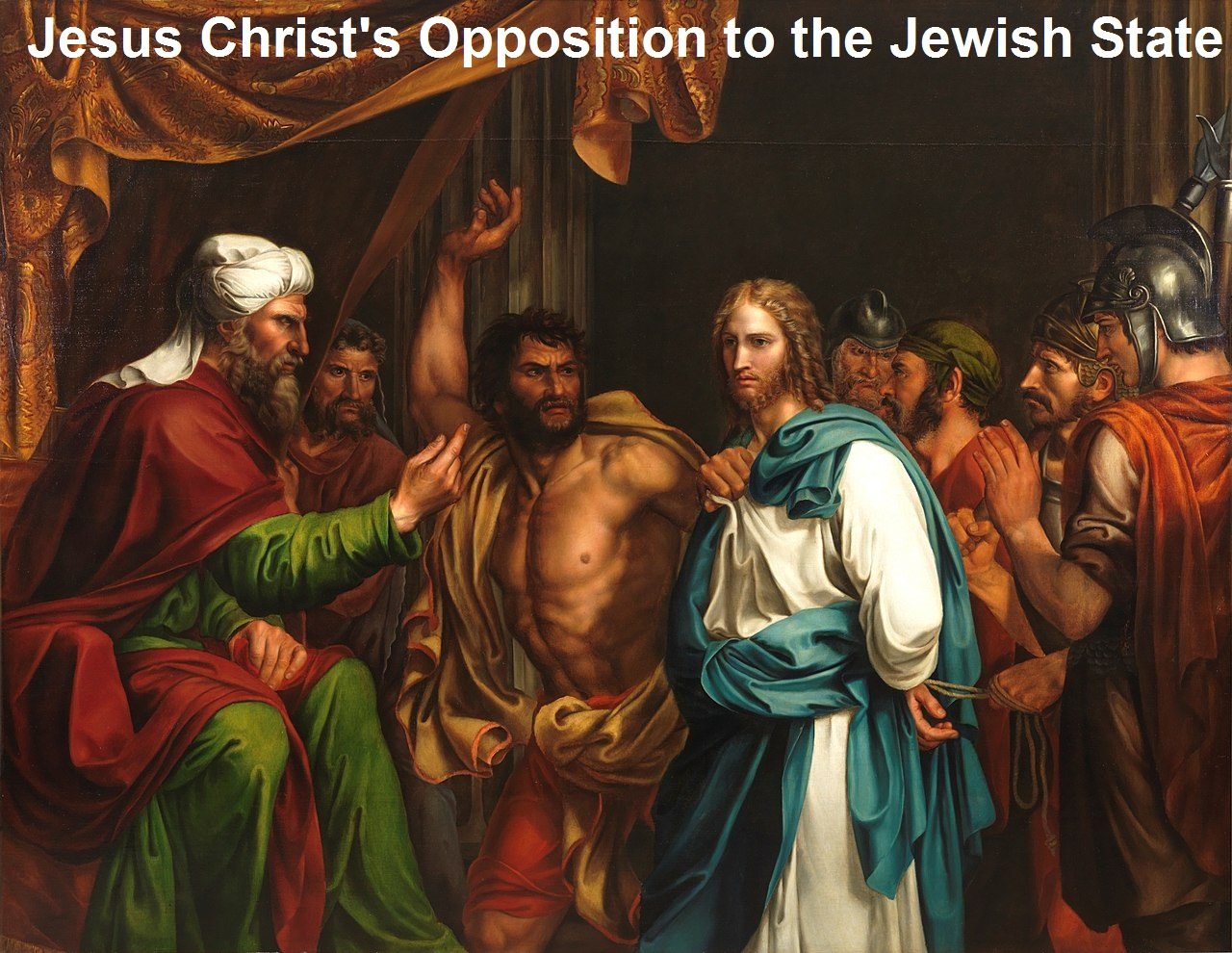
Jesus Christ’s Opposition to the Jewish State: Lessons for Today [22]
 [22]
[22]
Identifying the Luciferian Globalists Implementing the New World Order – Who are the “Jews”? [23]
 [23]
[23]
The Seal and Mark of God is Far More Important than the “Mark of the Beast” – Are You Prepared for What’s Coming? [24]
 [24]
[24]
The Satanic Roots to Modern Medicine – The Image of the Beast? [25]
 [25]
[25]
Medicine: Idolatry in the Twenty First Century – 10-Year-Old Article More Relevant Today than the Day it was Written [26]
 [26]
[26]
 [27]
[27]
Having problems receiving our emails? See:
 [28]
[28]
How to Beat Internet Censorship and Create Your Own Newsfeed [28]
We Are Now on Telegram [3]. Video channels at Bitchute [29], and Odysee [30].
If our website is seized and shut down, find us on Telegram [3], as well as Bitchute [29] and Odysee [30] for further instructions about where to find us.
If you use the TOR Onion browser [31], here are the links and corresponding URLs to use in the TOR browser [31] to find us on the Dark Web: Health Impact News [32], Vaccine Impact [33], Medical Kidnap [34], Created4Health [35], CoconutOil.com [36].