




by Brian Shilhavy
Health Impact News
Last year (2025) I reported how there were hundreds of thousands of jobs unfilled to support the boom in data center construction, jobs that only human beings can fulfill. See:
The AI Revolution is About to Crash due to a Lack of Human Labor
Today, in August of 2026, the situation has only become worse as massive amounts of money continue to be increasingly spent on AI and data centers, while the human labor force continues to diminish.
This is all public knowledge, but it is not in the headlines or known much because people are still getting fat and rich on the AI data center spending.
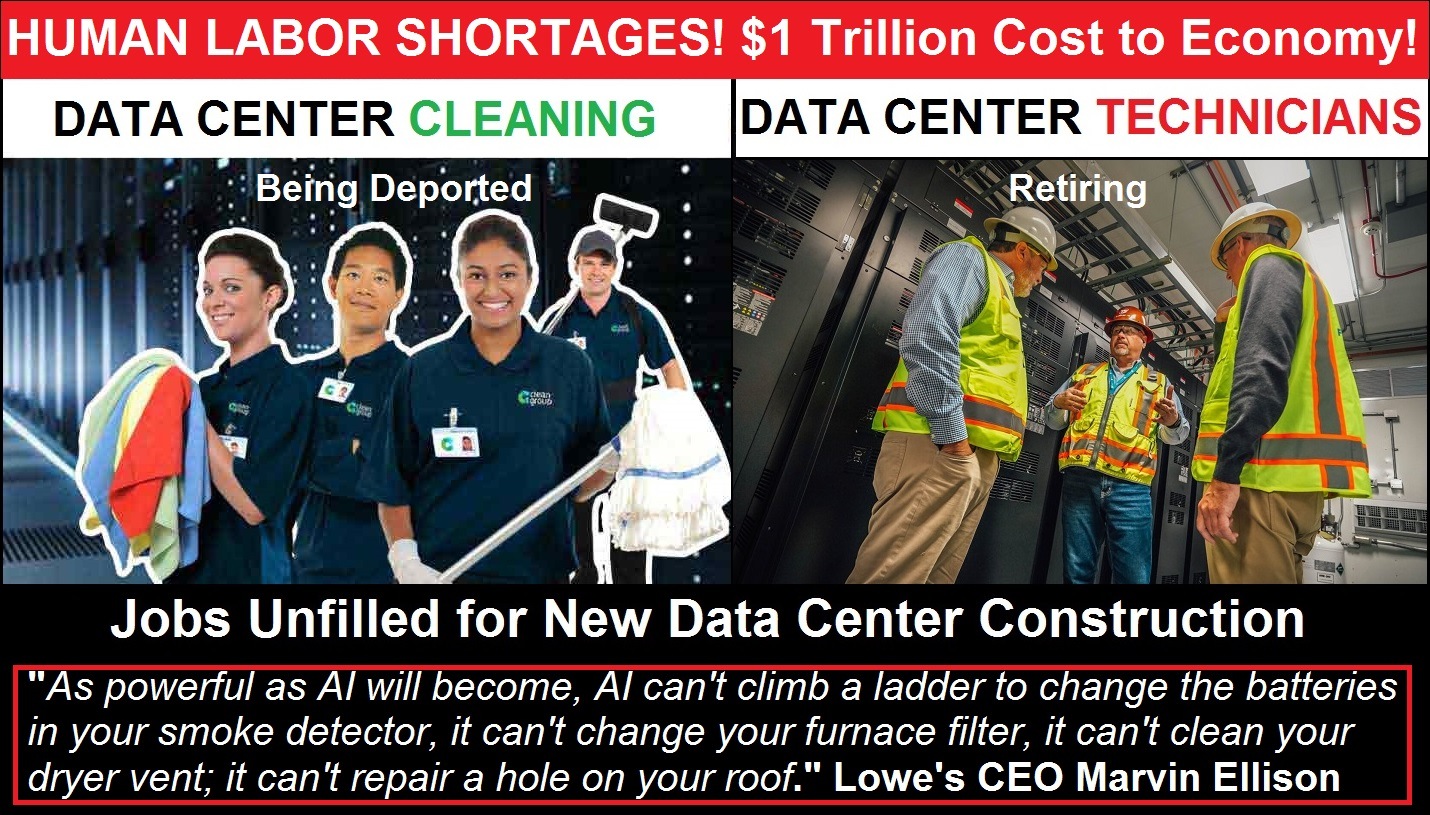
Earlier this year, a report was published by the U.S. Department of Education which stated that by 2030, an estimated 2.1 million skilled trades jobs in the U.S. could go unfilled, with potential economic losses reaching $1 trillion annually.
America’s ‘silent army’ of skilled tradespeople are retiring with no one to replace them—and the price tag could hit $1 trillion a year
Excerpts:
The workers who keep America’s buildings running are disappearing—and the U.S. isn’t replacing them fast enough to keep the lights on, the servers cool, or the labs sterile.
By 2030, an estimated 2.1 million skilled trades jobs in the U.S. could go unfilled, with potential economic losses reaching $1 trillion annually, according to U.S. Department of Education estimates cited in a new report from JLL shared exclusively with Fortune.
The commercial real estate giant calls the electricians, HVAC technicians, plumbers, pipe fitters, and maintenance workers who maintain the country’s built environment a “silent army”—a workforce that is aging out of the industry faster than it can be replaced.
“The silent army, as we normally call them, because they are hidden, invariably, behind the scenes, has been getting harder and harder not only to find, but retain in the industry,” Paul Morgan, JLL’s global COO of real estate management services, told Fortune.
Plus, “you’ve got this impending retirement wave that has really been driving the industry a long period of time, and a lack of new entrants.”
Morgan is referring to the fact that millions of tradespeople in the U.S. are nearing or at retirement age. More than one in five construction workers is currently older than 55, according to Associated Builders and Contractors.
As of May 2023, about 39% of electricians were 45 years old or older, a Consumer Affairs report shows, and there’s a 5:2 retirement-to-replacement ratio in manufacturing, construction, and other skilled trades, an Education Department report shows.
The supply-demand imbalance has hit crisis territory. Last year alone, nearly 600,000 jobs were posted for major skilled trades positions in the U.S., while only about 150,000 new workers entered the labor pool through apprenticeship programs, according to JLL.
A hidden workforce behind the AI boom
The shortage has caught the attention of some of the country’s most prominent executives, who argue that the U.S. cannot build the infrastructure for AI it’s betting its economic future on without the people to wire, cool, and maintain it.
Ford CEO Jim Farley has consistently warned about the gap, arguing America’s AI ambitions are running headfirst into a labor wall.
“I think the intent is there, but there’s nothing to backfill the ambition,” Farley told Axios last fall.
“How can we reshore all this stuff if we don’t have people to work there?”
Hadrian CEO Chris Power, whose company automates defense manufacturing, has gone further, predicting a wage shock in the trades.
“All the white-collar jobs are going to get automated,” Power said in a recent interview with tech publication Sourcery at the Hill and Valley Forum.
“I think we’re going to see massive hyperinflation in blue-collar salaries.”
Power added that even with robotic welding on his own factory floor, he still can’t hire enough welders to meet demand from the U.S. Navy.
“Everyone, go tell your kids to quit college and university and go get a welding certification,” Power added.
“The country needs you.”
Morgan argues the skilled trades are foundational to nearly every high-growth sector of the economy—a story he says the industry has failed to tell.
But one problem is the lingering perception that blue-collar work isn’t as elite or prestigious as white-collar work.
“As powerful as AI will become, AI can’t climb a ladder to change the batteries in your smoke detector,” Lowe’s CEO Marvin Ellison told Fortune earlier this month.
“It can’t change your furnace filter; it can’t clean your dryer vent; it can’t repair a hole on your roof.”
Morgan also questioned:
“Why wouldn’t somebody want to be an HVAC tech or an electrician or refrigeration specialist in the data center industry?“
He added, “You can’t have AI without data centers supporting them.”
Then today, Fox News published an opinion piece (NOT headline news, as it should be!), admitting that electricity shortages are on the horizon for Americans, due to human labor shortages.
The machines that keep America alive are failing. We forgot how to replace them
We’ve finally admitted that electricity is as essential as water, but we did so too late to avoid disruption
by Brian Tochman
Fox NewsExcerpts:
For 20 years, electricity was the most boring business in America, and our industry built its whole infrastructure strategy around the assumption that things would stay that way.
The numbers tell the story. From 2010 to 2020, U.S. electricity consumption fell by roughly 1%. LEDs, efficient motors and tightening appliance standards quietly cancelled out the electricity used by every new subdivision, factory and data hall, and then some. Demand was flat, and planners treated this as a permanent fact of life rather than as what it actually was: an intermission.
No-growth industries make choices that are perfectly rational, yet corrosive. You don’t fund apprenticeships when there’s no new capacity to staff. You don’t keep spare metallurgical know-how on the payroll when nobody’s ordering. You don’t recruit ambitious 25-year-olds into a sector whose pitch is “stable, essential, and never going anywhere.”
So, the utilities didn’t. The transformer makers didn’t. The steel mills didn’t. The workforce aged in place and the labor pipeline behind it ran dry.
We mistook a flat line for stability and in doing so, allowed a slow decay to occur. Then the line broke.
Since 2020, electricity consumption has reversed two decades of decline and climbed about 7%. Demand for large power transformers, the equipment through which nearly all of America’s electricity passes at some point, has surged 116% since 2019. Data centers, reshoring, electrification and grid hardening all arrived in the same handful of years, descending on an industry that had bought into the idea that it would never grow again.
Facing resurgent demand, we went looking for the people and the parts to meet resurgent demand, and here is what we found: America had forgotten how to make pipes.
Roughly 80% of the large power transformers the United States installs are now imported.
The grain-oriented electrical steel at the heart of every one of them has but a single domestic producer. Lead times for a standard power transformer have stretched to nearly two and a half years, and the larger units that connect power plants to the grid run longer still.
Prices are up more than 77% since 2019. The average transformer already humming away on the American grid is 38 years old, and more than 70% of the fleet is past age 25.
We are simultaneously trying to replace an aging base and build an entirely new one with a supply chain we spent a generation hollowing out.
The hardware shortage gets the headlines. The human one is worse, because you can’t expedite it.
A person cannot, today, enroll anywhere in America to learn how to design or build a large power transformer. The handful of university power-engineering programs that survived the last two decades don’t teach it. They were shrinking before the boom began as students chased software and AI instead.
The knowledge to wind a coil, design a core or run a high-voltage acceptance test is tribal, passed hand-to-hand on a shop floor by master winders, test engineers or metallurgists who understand why a core behaves the way it does. The expertise lives in people, much of it never written down, and roughly half the utility workforce is now over 45 with a large share eligible to retire this decade.
You can stand up a new transformer factory in a couple of years. You cannot conjure an experienced winder in a couple of years, and you can’t enroll one either.
Not referenced in any of these reports, of course, is how so much of the human labor force in the U.S., including factory workers, have now been deported from the U.S. due to Trump’s immigration policies, and many of these people deported were even here legally and Green Card holders.
A total system collapse is inevitable.
Comment on this article at HealthImpactNews.com.
This article was written by Human Superior Intelligence (HSI)


See Also:
Understand the Times We are Currently Living Through
The Brain Myth: Your Intellect and Thoughts Originate in Your Heart, Not Your Brain

Is God’s Patience About to Run Out on the United States?

Second Edition of eBook Released: The Concept of the American Christian Family is a Myth and is NOT Found Anywhere in the Bible – by Brian Shilhavy

FREE eBook! Restoring the Foundation of New Testament Faith in Jesus Christ – by Brian Shilhavy

KABBALAH: The Anti-Christ Religion of Satan that Controls the World Today

Exposing the Christian Zionism Cult

The Bewitching of America with the Evil Eye and the Mark of the Beast

Jesus Christ’s Opposition to the Jewish State: Lessons for Today

Identifying the Luciferian Globalists Implementing the New World Order – Who are the “Jews”?

The Seal and Mark of God is Far More Important than the “Mark of the Beast” – Are You Prepared for What’s Coming?

The Satanic Roots to Modern Medicine – The Image of the Beast?

Medicine: Idolatry in the Twenty First Century – 10-Year-Old Article More Relevant Today than the Day it was Written


Having problems receiving our emails? See:

How to Beat Internet Censorship and Create Your Own Newsfeed
We Are Now on Telegram. Video channels at Bitchute, and Odysee.
If our website is seized and shut down, find us on Telegram, as well as Bitchute and Odysee for further instructions about where to find us.
If you use the TOR Onion browser, here are the links and corresponding URLs to use in the TOR browser to find us on the Dark Web: Health Impact News, Vaccine Impact, Medical Kidnap, Created4Health, CoconutOil.com.